 View full screenshot ↗
The saved wording · verbatim
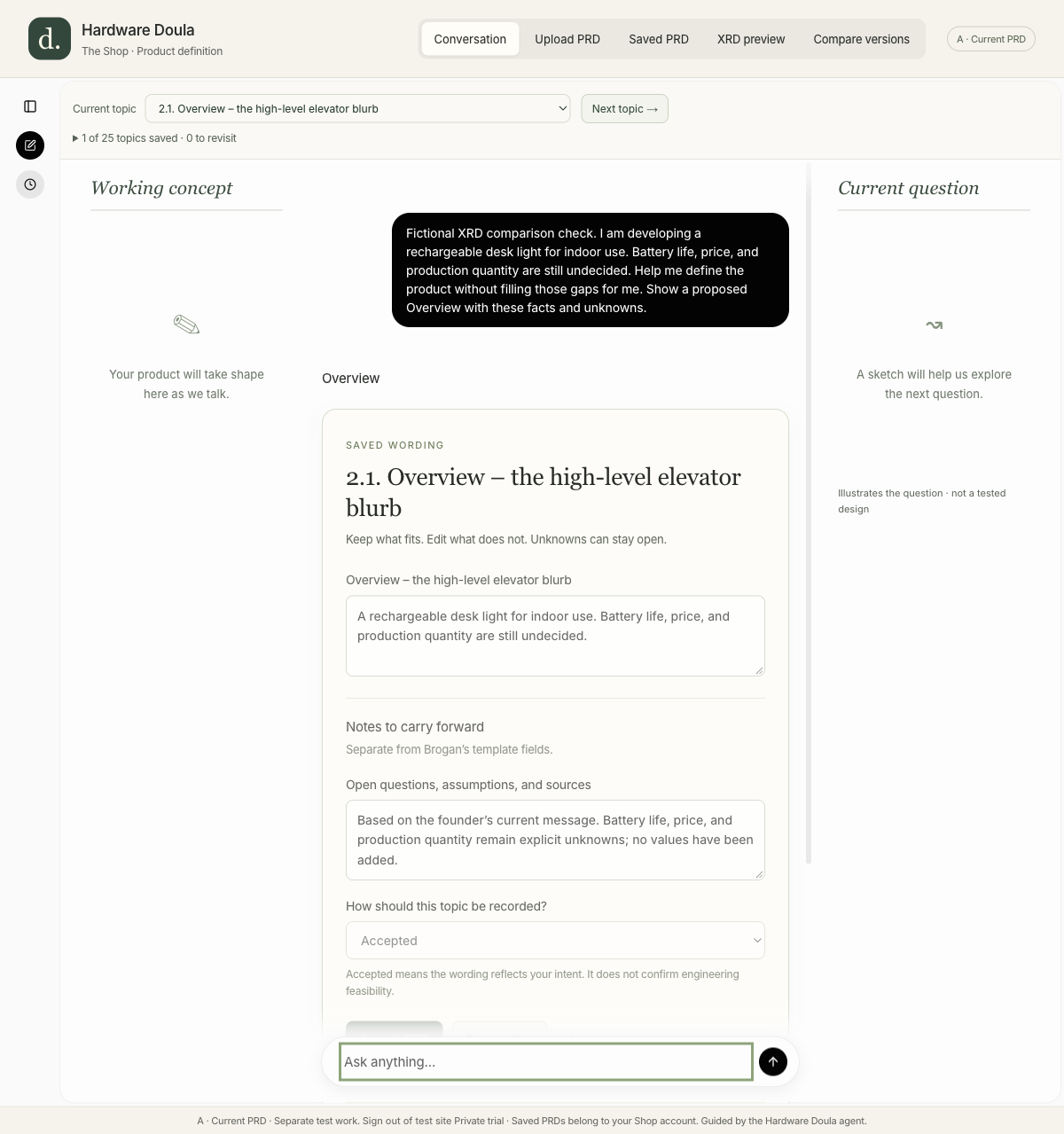
A rechargeable desk light for indoor use. Battery life, price, and production quantity are still undecided.
A worked example · October 21, 2026
We put the same fictional desk light through both versions of Hardware Doula. Here is what happened, what changed, and what we still need to learn.
Both versions kept the facts and the unknowns. The XRD changes how requirements are organized and connected. This example does not yet show that it produces a better definition.
Keep the starting point the same
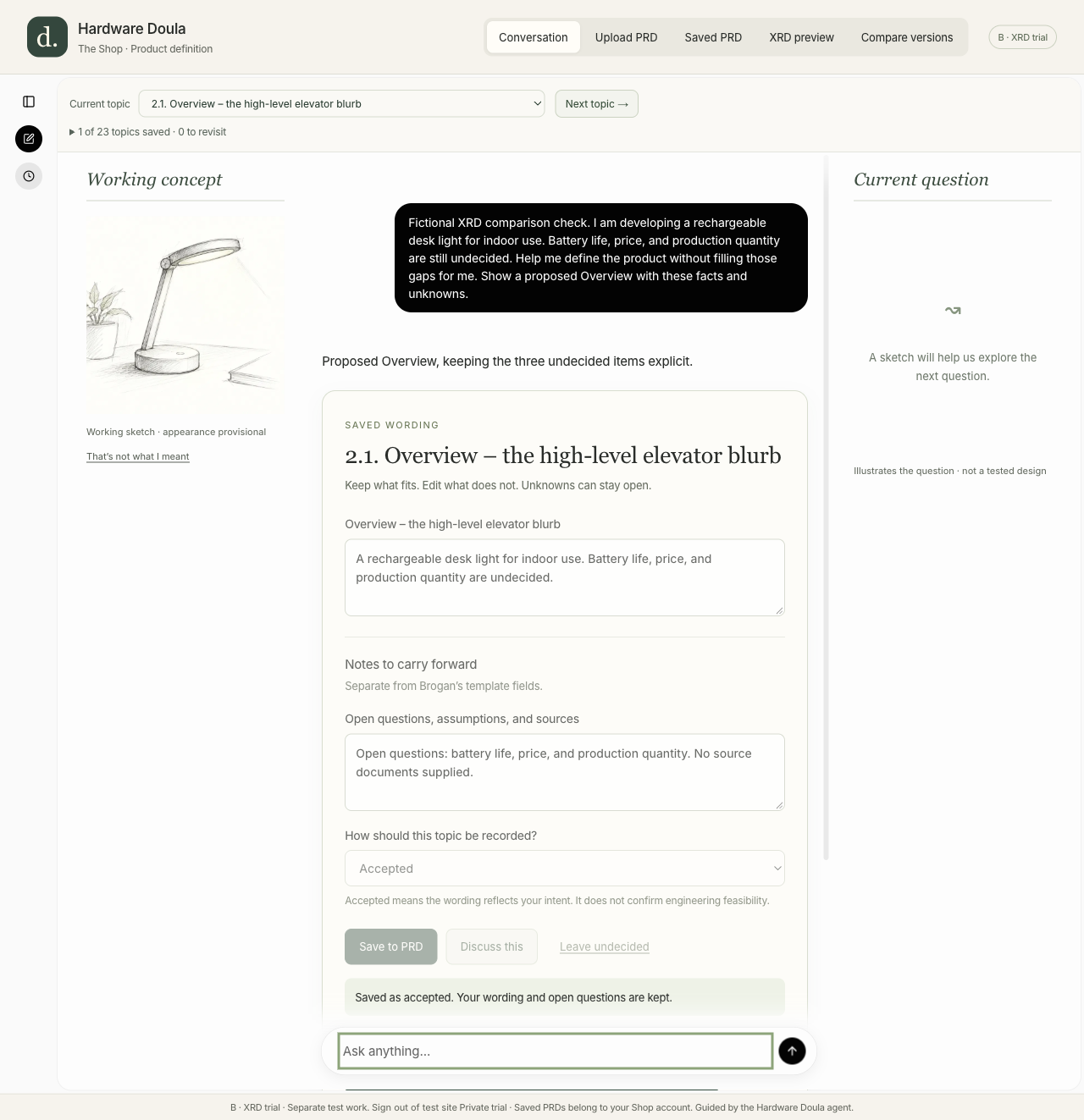
“I am developing a rechargeable desk light for indoor use. Battery life, price, and production quantity are still undecided. Help me define the product without filling those gaps for me. Show a proposed Overview with these facts and unknowns.”
The complete submitted message began with “Fictional XRD comparison check.” Both sites received the same message.
Look at the actual results
These are captures from the completed October 21 trial, after saving. Open either image to read the full screen.
View full screenshot ↗The saved wording · verbatim
A rechargeable desk light for indoor use. Battery life, price, and production quantity are still undecided.
 View full screenshot ↗
The saved wording · verbatim
A rechargeable desk light for indoor use. Battery life, price, and production quantity are undecided.
The shared foundation
Both use the Hardware Doula agent and the same conversation interface. This compares templates, not two different assistants.
In this example, neither version filled in battery life, price, or quantity. An unfinished decision remained unfinished.
Both proposed wording before acceptance. The accepted Overview survived reload, and both produced a Word document.
Where the templates diverge
The first saved paragraph looks similar because the Overview is shared. The source templates reveal more substantial differences further into the work.
A · Current PRD25 topics in the September PRD.
B · XRD trial23 topics in the October XRD, with a dedicated Engineering section.
What this could meanFewer topics does not mean less work. The grouping and detail change.
A · Current PRDFeature and application tables without the XRD’s ID and Lineage columns.
B · XRD trialAdds requirement IDs and Lineage fields—a place to connect a requirement to its origin or related requirement.
What this could meanPotentially easier to follow why a requirement exists. That benefit still needs a real-project review.
A · Current PRDTechnical, miscellaneous, and environmental tables in the earlier structure.
B · XRD trialSeparate environmental, hardware, and software tables, with specifications and requirement references.
What this could meanMore explicit places for engineering detail; deciding where a requirement belongs may take more guidance.
A · Current PRDIncludes current-design and product-inspiration headings.
B · XRD trialThose headings and some earlier tables have no direct counterpart.
What this could meanMoving a real project needs a human review. Earlier notes must be preserved, not silently discarded.
These structural differences come from the September 21 and October 19 source templates. The possible benefits are interpretations to test, not measured improvements.
Our recommendation
The basic save-and-export path works in both. Next, compare whether the XRD makes Brogan’s actual project clearer, easier to review, and less work to correct.
ClarityDo the questions and topic groups make sense?
Useful detailDo requirement references help, or add work?
FaithfulnessDo corrections, sources, and unknowns stay intact?
Sign-in required for the trials. Each keeps its own conversations and saved work. Brogan’s usability and engineering review are still pending.
One matched fictional example demonstrates the Overview, explicit acceptance, reload, and export. It is not a complete engineering review or a controlled measure of quality, time saved, or ease of use. Agent wording and sketches can vary.
A separate XRD upload test exercised requirement rows and corrections. It was not a matched comparison, so it is not used here to rank the versions. One source-discussion reply gave an unverified line location for a real passage; source-location accuracy remains open.
Screenshots were captured on October 21, 2026 from application release 26c74f7, before the custom domain names were added. The original captures are preserved; their viewport widths differ slightly. They contain a fictional project and no client documents. The later domain release verified a real Doula reply on each new address.